






TarteebHome buying guides · Reviewed 26 October 2026
Turn a material name into useful questions
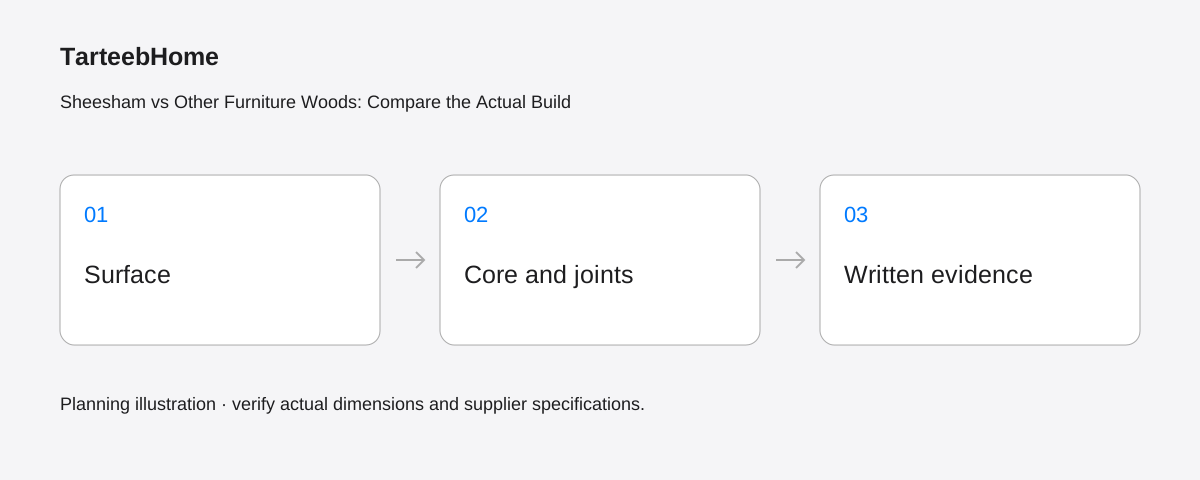
A furniture description often begins with a wood name, but the practical purchase is a complete object. Ask which components use that wood, what is beneath each visible surface and how the piece is assembled. Compare the same components across quotations. A table with a veneered top and solid-timber legs should be described that way rather than compressed into a misleading all-solid claim.
Sheesham is commonly associated with Dalbergia sissoo. Kew accepts that botanical species and lists Pakistan within its native range. A seller still needs to substantiate the timber used in the actual piece. A species reference cannot authenticate an upload, a stain colour or a supplier’s verbal assurance.
Separate solid wood, veneer and the core
The USDA Wood Handbook distinguishes solid wood from manufactured wood-based materials. Veneer describes a thin wood surface; it does not identify the core beneath it. Plywood, particleboard and fibreboard describe different panel constructions. Their suitability depends on the specified product and the way the furniture uses it.
Ask the maker to identify the visible surface and the underlying component separately. For a wardrobe, request the carcass, back, door and shelf specification. For a dining table, request the top, edge, base and connection detail. Avoid treating every engineered panel as the same material, or every solid-wood build as equally well constructed. Inspect the actual proposal rather than rank entire categories from a photograph.
Compare woods without invented performance promises
If comparing sheesham with walnut, oak, pine or another wood, ask for the exact species or commercial designation, component use and available evidence. Common names can be used loosely. Request a finish sample and ask how natural variation will be handled across a set. Do not infer species from a dark finish or insist that one sample predicts every board’s appearance.
Discuss the use case: a decorative console, an everyday chair and a large cabinet place different demands on a build. Ask about joints, support, repairability and the supplier’s documented limits. A higher price does not prove better material, and a lighter piece does not establish poor quality. A meaningful comparison needs the actual specification, not a sweeping ‘best wood’ claim.
Ask about preparation and the intended room
USDA’s moisture research explains that wood exchanges moisture with its surroundings and that dimensional behaviour varies. Ask the maker how the supplied furniture has been prepared for its intended indoor environment. Avoid demanding an unsupported universal moisture value or accepting ‘fully seasoned’ without an explanation of the maker’s process.
Record known site conditions such as a damp wall or a history of leaks. Ask for the product’s care and placement guidance. Keep direct water exposure and heat sources in that discussion, and obtain instructions for the actual finish. Do not assume a polish, a marketing label or a panel’s colour makes the whole assembly waterproof or maintenance-free.
Use a comparison sheet with evidence gaps visible
Use columns for component, material or species, surface finish, construction, documentation, care, price inclusion and unanswered questions. If a seller cannot confirm a component, write ‘not confirmed’ instead of substituting a likely material. This gives both parties a concrete basis for a revised quotation.
For example, two consoles may look similar while one includes solid-timber doors and the other specifies a veneered panel door. Ask for samples and the construction details that matter to your intended use. Compare total delivered scope, repair arrangements and actual warranty terms. Do not convert a design-library price estimate into a confirmed market offer or present a supplier’s undocumented claim as independently tested fact.
Keep sourcing and origin claims specific
Ask who made the item, where the relevant production occurred and what evidence supports any origin or certified-sourcing claim. A Pakistani design influence is not a manufacturing certificate. A timber species native to the region does not establish where that particular wood was harvested. Keep seller documentation attached to the relevant product rather than apply an assurance to every listing.
Use our practical wood guide for component terminology and furniture quotation guide to structure an enquiry. Explore craft and material inspiration with those distinctions in mind. Final materials, dimensions, availability, price and fulfillment belong to the confirmed seller offer, not the appearance of a concept rendering.
Sources and review notes
Technical references support the specific points identified above. They do not endorse TarteebHome or verify individual seller claims. Source photographs and technical drawings have not been reproduced.
- Royal Botanic Gardens, Kew, Plants of the World Online: Dalbergia sissoo
- USDA Forest Products Laboratory, Wood Handbook, FPL–GTR–282
- USDA Wood Handbook, Chapter 4: Moisture Relations and Physical Properties
Editorial review: TarteebHome editorial desk. Sources checked 26 October 2026. Recheck product and supplier facts before any purchase.